
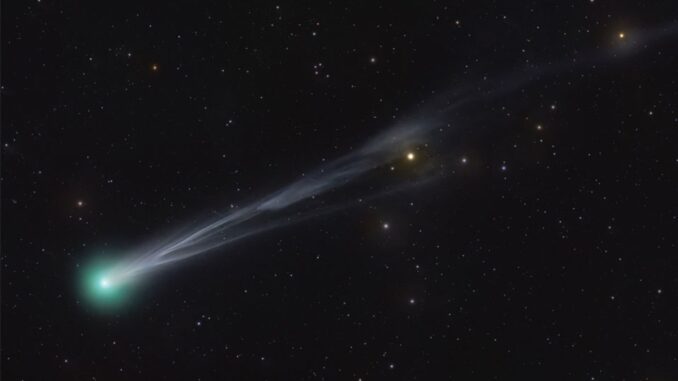
Comet C/2025 A6 (Lemmon) is one of the most exciting new discoveries of the year — a distant icy visitor now making its way through the inner Solar System and brightening steadily as it approaches the Sun. The comet was first discovered in January 2025 by the Mount Lemmon Survey in Arizona, a program dedicated to tracking near-Earth objects and other celestial bodies. Follow-up observations confirmed it as a long-period comet on a steeply inclined orbit, set to reach perihelion (its closest point to the Sun) later this year.
Early measurements suggest the comet originated from the Oort Cloud, the vast spherical region of icy bodies surrounding our Solar System. Its orbit will bring it well within reach of small telescopes and binoculars, and if predictions hold, Comet Lemmon may even become visible to the naked eye during its peak in late autumn.
Quick Facts
- Designation: C/2025 A6 (Lemmon)
- Discovery: 3 January 2025 – Mount Lemmon Survey, Arizona
- Closest approach to Earth: 21 October 2025 (0.596 AU)
- Perihelion: 8 November 2025 (0.53 AU)
- Estimated peak brightness: Magnitude 3–4
- Best viewing: Mid-October – early November 2025 (evening sky, northwest)
A Long-Period Comet with a Dramatic Path
C/2025 A6 (Lemmon) will reach perihelion — its closest approach to the Sun — on 8 November 2025, passing just 0.53 AU (79 million km) from our star. Its closest approach to Earth happens slightly earlier, on 21 October, when it will sweep by at about 0.6 AU. This geometry means the comet will appear brightest to us in the second half of October and the first days of November, making this the prime observing window.
Because the comet’s orbit is tilted more than 140 degrees relative to the plane of the planets, it appears to race through the northern skies at a sharp angle. It’s now rising high enough after sunset to be visible to northern-hemisphere observers and will continue its sweep southeastward each evening as it nears the Sun.
How Bright Will Comet Lemmon Get?
Predicting a comet’s brightness is always tricky — they are volatile, dusty, and prone to surprises. But Comet Lemmon has already exceeded early expectations. Initially expected to remain faint, it has brightened steadily since summer 2025, with visual reports placing it around magnitude 4–5 by mid-October. Under dark skies, that makes it potentially visible to the naked eye, and an easy catch with binoculars.
If its current trend continues, Lemmon could peak around magnitude 3–4 near the end of October — bright enough to show a short tail and a softly glowing green coma, caused by diatomic carbon (C₂) and cyanogen (CN) fluorescing in sunlight. Even if it falls slightly short of that prediction, it should remain one of the most photogenic comets of the year, easily visible through binoculars or small telescopes.
Where and When to Look
By mid-October, Comet Lemmon has transitioned from the morning sky into the evening. It is currently best seen from the Northern Hemisphere, glowing faintly in the north-west after sunset. Around 16 October, it passes very close to the bright star Cor Caroli in the constellation Canes Venatici — an excellent landmark for finding it. At this time, it sits beneath the handle of the Big Dipper, giving observers an easy star-hopping route from one of the sky’s most recognisable patterns.
Each evening, the comet moves several degrees eastward, shifting lower toward the horizon by early November. Between 20 October and 1 November, it will be at its brightest and best placed for viewing — a period that coincides neatly with its closest approach to Earth. After perihelion on 8 November, it will gradually fade and slip into twilight, though it may remain detectable in binoculars into late November.
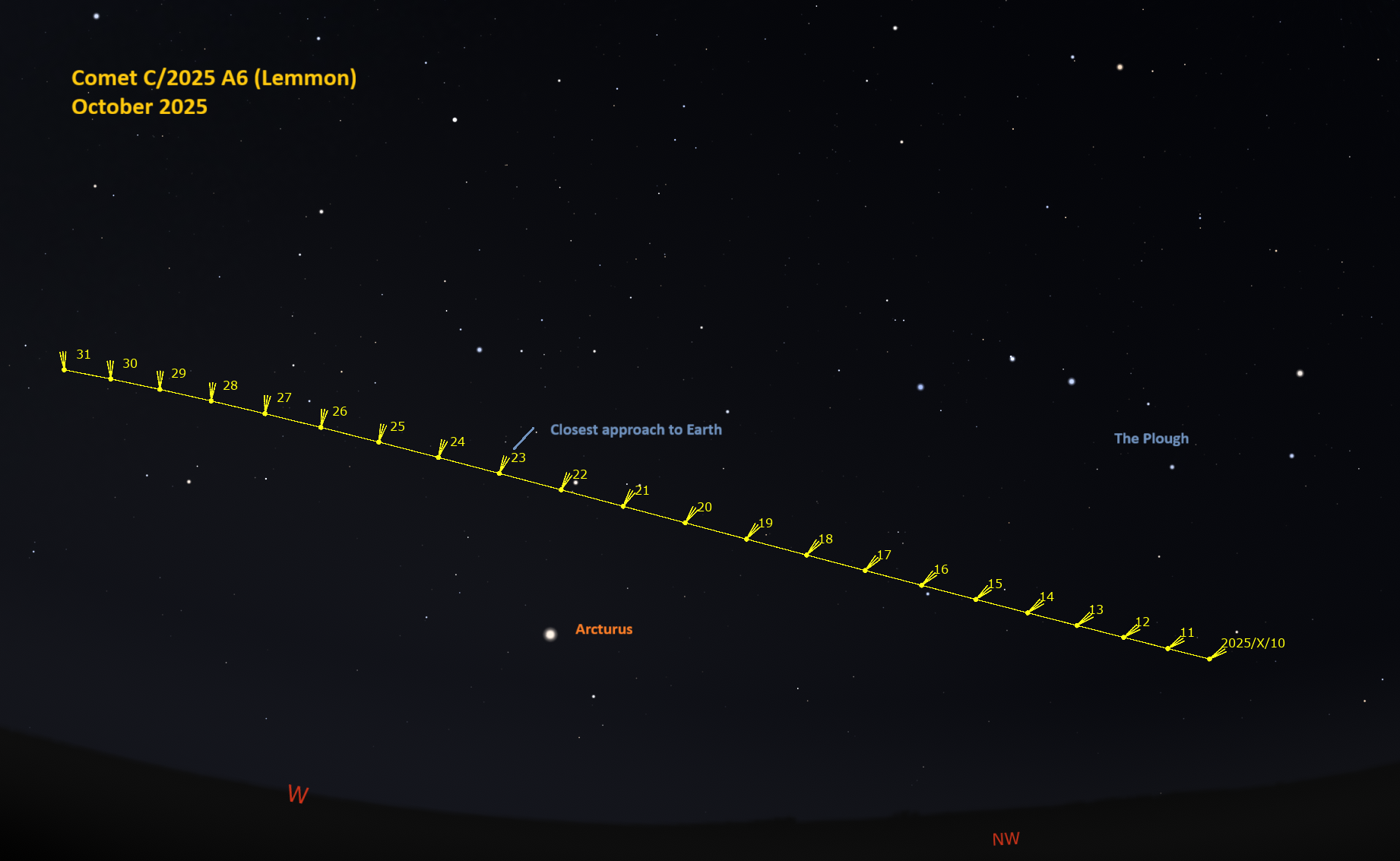
(Click to enlarge)
Observing Tips
If skies are clear, the best time to look is about 45 minutes after sunset, once twilight has faded but before the comet sinks too low. Find a spot with a clear, unobstructed north-west horizon and minimal light pollution. Start by locating Cor Caroli, then sweep the area with binoculars — the comet should appear as a diffuse, slightly greenish patch of light.
Even a modest pair of 7×50 or 10×50 binoculars will show the comet’s fuzzy coma, while small telescopes can begin to reveal tail structure and brightness variations. For photography, a telephoto lens or short-focal-length telescope will capture a lovely green glow and a faint blue ion tail stretching away from the Sun.
A Visitor from the Deep
Like all long-period comets, C/2025 A6 (Lemmon) originates from the distant Oort Cloud, a vast reservoir of icy bodies at the edge of the Solar System. It may have spent millions of years there before a gravitational nudge from a passing star or the galactic tide sent it plunging toward the Sun. After this brief encounter, Lemmon will head back out into the dark — not to return for over a thousand years.
With its graceful orbit, soft green glow, and accessible timing, Comet Lemmon is shaping up to be one of the highlights of the 2025 night sky. Whether you’re an experienced observer or simply curious about what’s overhead, October and early November offer your best chance to see this rare wanderer before it disappears into the depths once more.